The Uber ride to the airport after a conference is always a little surreal. The noise drops away. The adrenaline of being around thousands of peers starts to fade, and a week of late nights spent... networking... finally catches up with you.
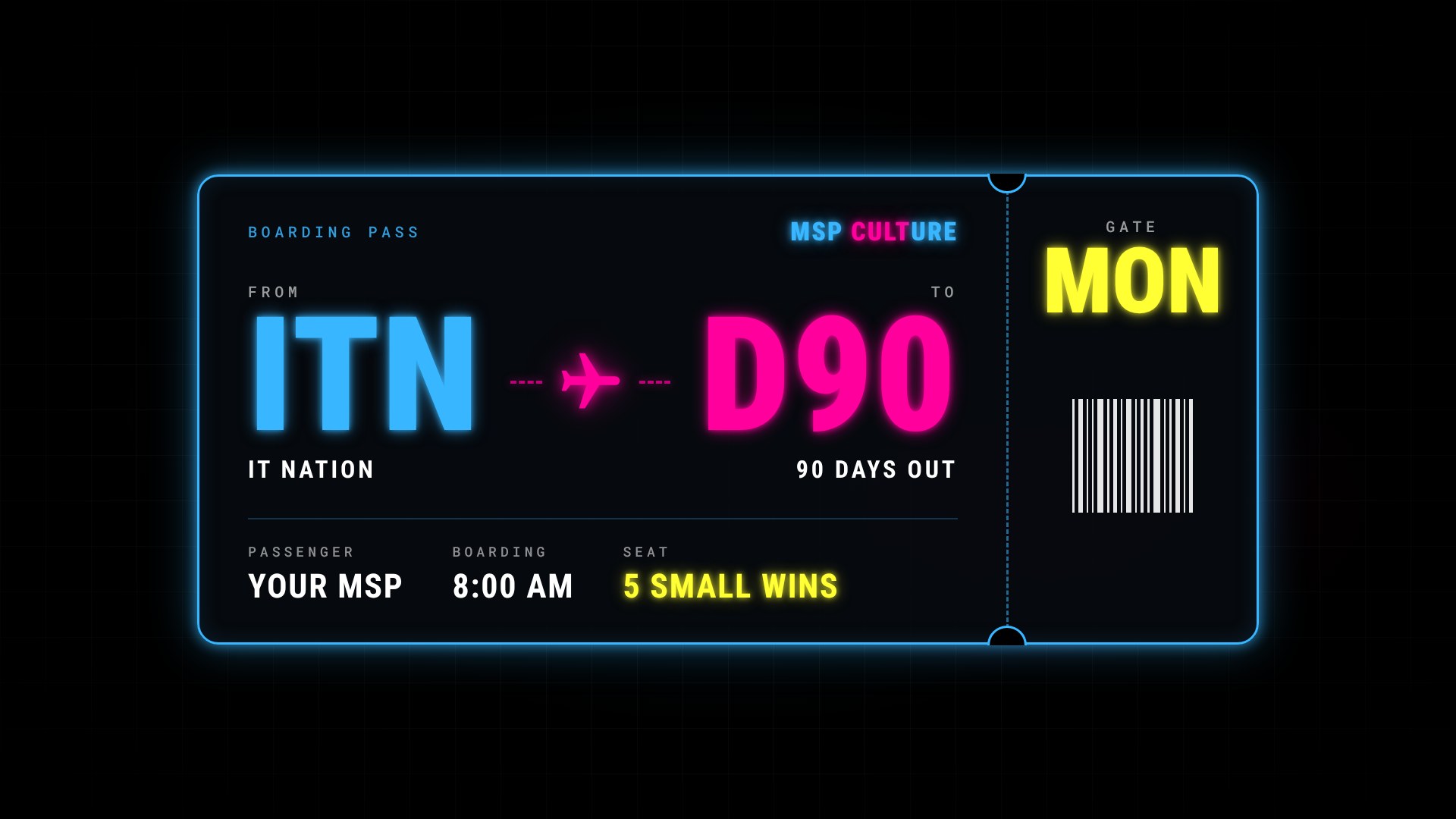
By Monday morning, the sharpest points of the show will already be a little duller. So I use the two hours at the gate to get clear. Before I board, I write down what needs to happen over the next 90 days.
That habit is the whole idea behind Return on Attendance, the free workbook I built, because swag doesn't count as ROI. This edition is my list from the gate after IT Nation Connect 2026 in Orlando: three days, about 4,000 MSP owners, operators, and vendors, and more AI than anyone could absorb.
The numbers I kept coming back to came from Service Leadership's benchmark data. Tool costs are going up, headcount costs are going down, and the W2 multiple keeps climbing. That isn't people being replaced. It's the best MSPs growing without hiring at the same pace. Tools are doing the work that used to require the next hire. That's the path, and every takeaway below points at it.
Here's what made the list: four takeaways, and a 90-day plan any MSP can start Monday, whether you were in Orlando or not.
1. AI is here. If you aren't using it, you're late.
Not early. Not "evaluating." Late.
Every major platform on that show floor is shipping AI into the PSA, the RMM, the security stack, and the helpdesk. Your clients are already pasting their contracts into chatbots. Your techs are already using it, with or without a policy that says they can.
Here's the part the keynotes won't tell you. The MSPs getting real value from AI aren't having a revolution. They're stacking up small wins. Ten minutes saved on ticket triage. Time entries cleaned up before billing. QBR prep that takes an hour instead of a morning. A PowerShell script nobody wanted to write. An escalation caught before it bounced to the wrong tier.
None of those makes a great keynote demo. Twenty of them together is the growth-without-hiring story in the SLI numbers.
Small wins also teach you where AI is brilliant and where it confidently makes things up, and that learning is the moat. You can't buy it at a booth, and you can't skip it. Stop waiting for the big transformation and go find your first five small wins.
2. The platforms will change. Don't wait for the knife fight to end.
Right now the AI features are cheap, bundled, or "included for a limited time." That's not generosity. That's a land grab. Every vendor is fighting for the same seat in your stack, and the knife fight for market share is just getting started.
It will end the way these always end. A few winners, consolidated pricing, and a per-agent or per-action line item on your invoice that wasn't there last year.
The mistake is waiting for the dust to settle before you decide anything. By then the decision gets made for you, at their price.
So build with change in mind:
- Own your prompts. Keep them in a repo, versioned, documented. They're intellectual property now, same as your scripts and runbooks.
- Own your code and your workflows. If the logic only lives inside one vendor's builder, you don't own it. You rent it.
- Own your data. Know where your ticket history, documentation, and client context live, and how you'd get them out.
- Keep the model swappable. The best model this quarter probably won't be the best model next year. Design so you can change engines without rebuilding the car.
3. Be wary of "all-in-one."
The pitch is seductive. One platform, one login, one bill, one throat to choke. After years of tool sprawl, I get it. I've spent a lot of my career helping MSPs consolidate stacks that grew like weeds.
But consolidation and lock-in are not the same thing, and the line between them is getting thin.
Let's be fair about this. ConnectWise is a public example because it hosts the show, and earlier this year it launched the ConnectWise Platform (an Asio by any other name...), pulling PSA, RMM, security, automation, and agentic AI into one layer. They still talk about an open ecosystem, and some partners will get value from it. But when the company that owns your PSA also wants to own your RMM, your security stack, and your AI layer, its native tools will always get the best seat at the table. Third-party tools get whatever seat is left.
You could hear it in the AI sessions. Most of the conversation was about AI built into the platform, and some of it leaned on fear about everything else. One line from the stage: "Don't use Claude, a tech could wipe out your whole database in a single prompt."
That risk is real. But it's a permissions and process problem, mostly caused by the company telling you only they can keep you safe. Least privilege, human approval on destructive actions, and logging apply whether the AI lives inside your PSA or beside it.
"Only our AI is safe" isn't a security argument. It's a sales argument wearing a hard hat.
Lock-in rarely hurts on day one. It hurts at renewal, when the price goes up and your exit costs more than the increase.
Ask every platform vendor three questions before you go deeper:
- Can I export my data, workflows, and automations in a usable format?
- What happens to my integrations with your competitors next year?
- If I leave in three years, what does that cost me?
If the answers get vague, that is your answer.
So what does a good answer look like? Right now I think platforms like Neo Agent are the best play. It plugs into the PSAs MSPs already run, including ConnectWise, Autotask, and HaloPSA, instead of asking you to rip anything out. It ships prebuilt automations so you can get moving quickly. And when you outgrow those, you can build your own and keep your prompts as yours. That combination is what to look for in any AI platform: fast to start, open to your stack, and nothing that holds your work hostage.
4. The journey has started. Walk it before you sell it.
Your clients are going to ask you about AI. Many already are. "Should we use Copilot?" "Is it safe to put our data in ChatGPT?" "Can AI replace our receptionist?"
You can't credibly guide someone down a road you haven't walked. Reading the vendor brochure isn't walking it.
The twists and turns are where the value is. The prompt that worked great until it didn't. The automation that saved 10 hours a week and then quietly broke a workflow nobody documented. The data you didn't realize was sitting in a SharePoint site with "Everyone" permissions until an AI tool surfaced it. You want to hit those potholes in your own shop, not a client's.
Back in 2019 I wrote Automate Everything...Except Relationships. The tagline was "Automate To Save Humanity," and it holds up better now than it did then. AI should take the repetitive work off your people so they have more time for clients. It shouldn't replace the relationship. The MSPs who get through this journey first will be the ones clients trust to lead them through it.
The 90-day plan for every MSP
Conference energy has a half-life of about a week. By the second Monday back, the inbox has won and the notebook is in a bag somewhere. So don't leave it at notes. This plan works whether you have 5 techs or 150, and none of it requires buying anything.
Days 1-30: Get honest about where you are.
- Write an AI acceptable-use policy for your own staff. One page. Which tools are approved, what data never goes in, who to ask. Your techs are already using AI. Make it official and safe.
- Find out what's already in use. Survey your team and check your own tenant. Shadow AI is a security finding, not a moral failing.
- Inventory your stack for lock-in. For each core platform, write down what you own (data, scripts, prompts, workflows) and what you'd lose if you left.
- Name an owner. One person accountable for AI at your MSP. Not a committee. A committee is where good ideas go to get scheduled.
Days 31-60: Build your first five small wins.
- Pick five small wins. Each one should be a painful, repetitive internal task, like ticket triage, time entry cleanup, QBR prep, or documentation. Small and boring beats big and impressive.
- Build AI into each one with a human in the loop. Measure the time before and after. Track the misses as carefully as the wins.
- Put every prompt, script, and workflow in a repo you control. Version it like code, because it is code.
- Ask your platform vendors the three lock-in questions from above. Get the answers in writing.
Days 61-90: Turn what you learned into something clients can buy.
- Write down what broke, what worked, and what surprised you. That's your playbook and your sales story.
- Run a data-readiness check on your own tenant first: permissions, oversharing, retention. Then turn it into a client assessment.
- Pilot an AI readiness conversation with three friendly clients. Lead with their data and their risk, not with a product.
- Decide your platform posture for the next 12 months. Where you'll go deep with a vendor, and where you'll keep things portable on purpose.
At day 90 you won't be an AI expert. You'll be something more useful: an MSP that has actually done the work and can tell clients the truth about it.
"But security. But compliance."
I've spent most of my career on the security and compliance side of this industry. So I'll say it plainly. Those concerns are real, and they're exactly why you can't sit this out.
The risk isn't AI showing up in your MSP. It's already there. The risk is AI showing up without a policy, without approved tools, and without anyone checking what data is going where.
Regulated clients don't need you to say no to AI. They need you to know which tools fit inside their boundary, which don't, and how to prove it to an assessor. You only learn that by doing it. The 90-day plan starts with policy and data for a reason.
The map is being drawn right now.
Nobody has this figured out. Not the vendors, not the analysts, and definitely not the person on stage with the slickest demo.
That's the opportunity. The map is being drawn right now by the people walking the road. You can be one of them, or you can wait for someone else's map and pay whatever they charge for it.
Start Monday. Ninety days from now, you'll be glad you did.
What's on your list from IT Nation this year, and what's the first thing you'll actually change?